

The fiber that carries everything.
Patagonian Merino wool, and why it matters where it comes from.
If you've read the two previous pieces in this series, you know the families. The Trannacks, who crossed a continent on wagons to reach land no one had seen. The Sorzanas, who built one of Argentina's great textile empires from a backyard workshop in Buenos Aires. Two journeys. Two obsessions. One land.
The Trannacks and the Sorzanas never worked with the same material. The Trannacks worked land: Patagonian land, with its extreme climate and its grass, and the sheep that adapted to both over generations. The Sorzanas worked silk, then nylon, building three generations of knowledge about what it means to take a raw material seriously. How it behaves under pressure. What processing does to its character. What you lose when you rush it.
That knowledge doesn’t belong to a single fiber. It belongs to whoever carries it.
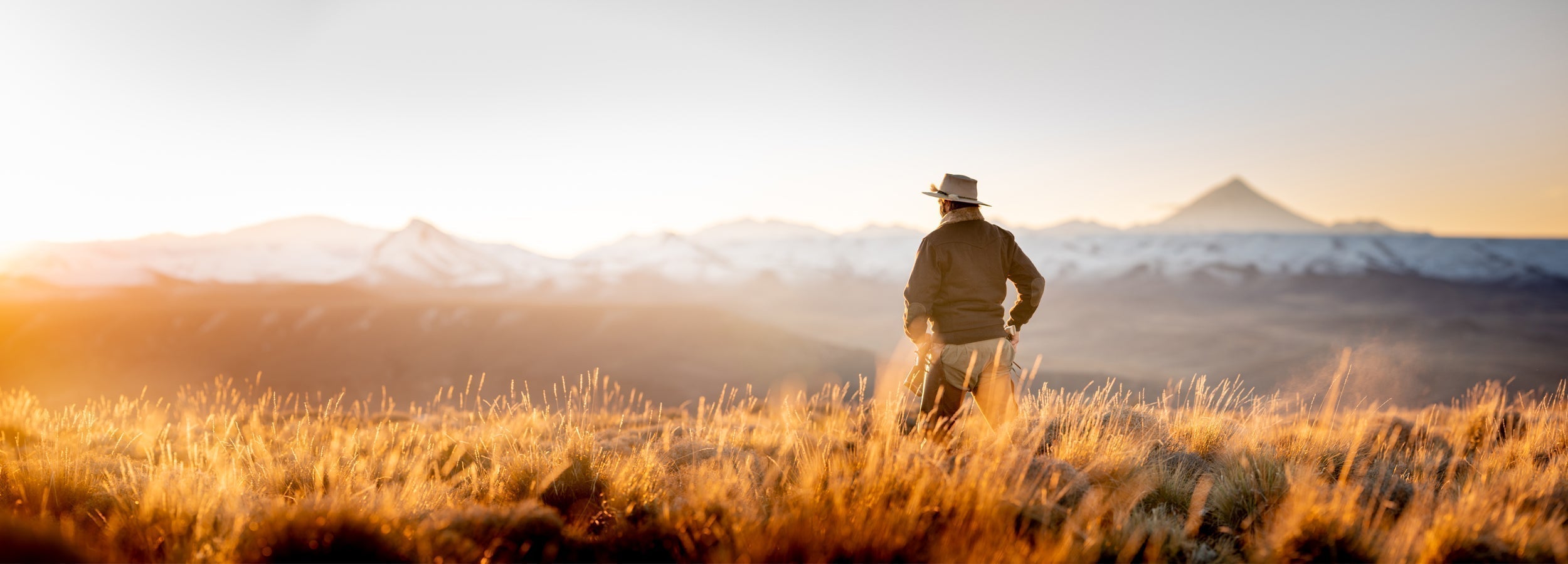
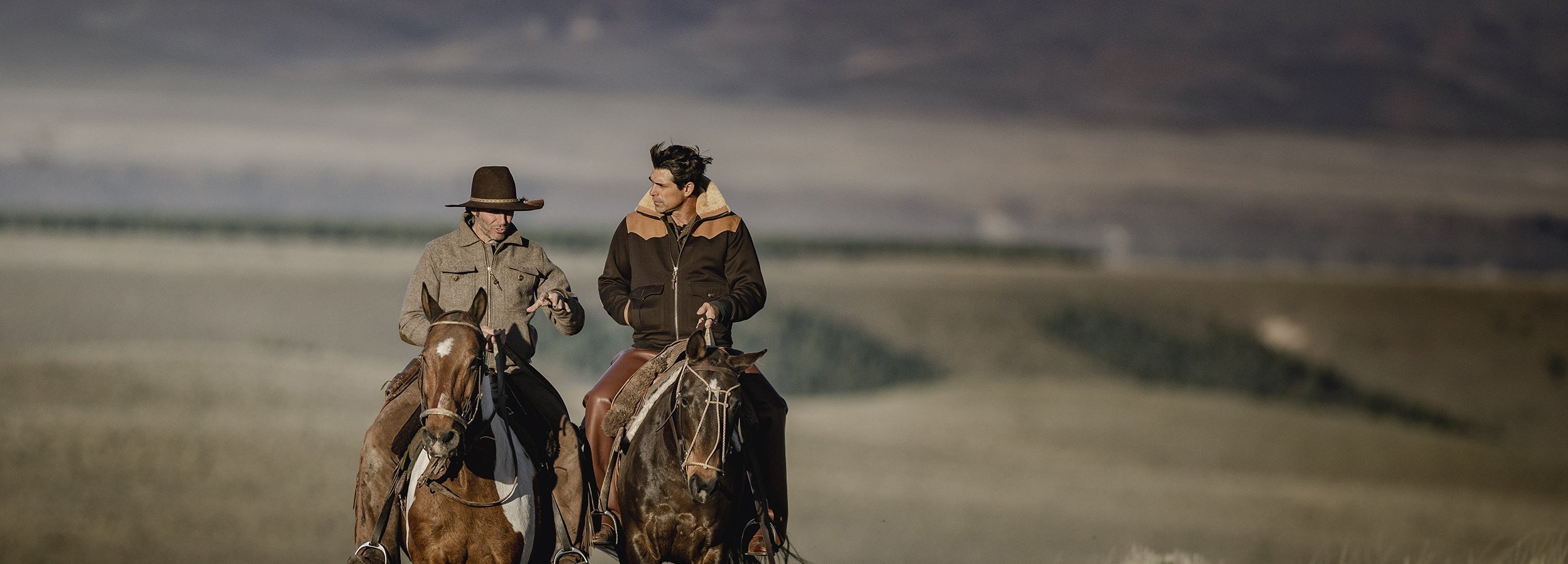
Ruso carries both. The land that produces this wool, the Patagonian steppe he grew up on, on horseback, in the wind, in the Zapala winters that don’t forgive. And the instinct for knowing what to do with a material once you have it, inherited from a family that spent four generations inside the textile industry.
That is why this article is about Merino wool. Not because it was inevitable. Because when you carry both of those things, it becomes the only material that makes sense.
What Merino is, and why geography is everything
Merino is a breed of sheep, originally from Spain, selectively bred for thousands of years to produce a fiber finer and softer than any other wool on earth. What makes Merino different from other wools is the fineness of its fiber: fine enough to bend against the skin rather than prickle it. The physics change. The experience changes entirely.
But here is the thing that most people selling Merino don’t tell you: the breed is only the starting point. The animal produces what its environment demands. Merino sheep raised in mild, uniform conditions produce a reliable, uniform fiber. Merino raised in extreme conditions, harsh winters, strong winds, dramatic temperature shifts, produces something different. The body of the animal adapts. The crimp deepens. The natural thermal regulation intensifies.
Patagonia is one of the harshest sheep-raising environments on earth. The steppe reaches 1,500 meters above sea level. The wind is constant and merciless. Temperatures swing from freezing nights to sharp summer heat within the same week. A Merino fleece produced in these conditions has had to earn its properties. The warmth isn’t manufactured, it is a biological response to a place that demands it.
Geography is not a detail. It’s the point.

What the fiber actually does
Merino wool is one of the few natural materials that is genuinely multi-functional, not because of processing, but because of its molecular structure. A few things worth understanding:
Thermal regulation.
Merino fiber has a natural crimp, a micro-curl, that traps air between fibers. That trapped air acts as insulation in the cold and as ventilation in the heat. The same garment keeps you warm at altitude and breathes in warmer conditions.
Moisture management.
Merino can absorb up to 35% of its weight in moisture without feeling wet. More importantly, it moves that moisture away from the skin through capillary action and releases it through evaporation. In practice, this means you can wear a Merino garment across different climates and different temperatures, adapting rather than accumulating.
Natural resistance to odor.
The same moisture-wicking properties that keep the skin dry also inhibit the bacterial growth that causes odor. Merino garments require less frequent washing, which matters both for the longevity of the piece and for the environment.
Memory and recovery.
The natural crimp in Merino fiber gives it an elastic quality. A well-made Merino garment recovers its shape after use. It doesn’t bag at the elbows or lose its silhouette. With proper care, it improves over years of wear rather than degrading.

Biodegradability.
Unlike synthetic fibers, Merino wool is fully biodegradable. At the end of a garment’s life, which in the case of a well-made piece can be measured in decades, it returns to the earth without leaving a trace. This is not a marketing claim. It is the chemical reality of a protein fiber that evolved in nature and belongs there.
Softness that doesn’t compromise structure.
Finer fibers produce softer fabric. But in outerwear, softness without structure is a liability. Patagonian Merino, because of the conditions in which it’s raised, produces a fiber fine enough to be comfortable against the skin while retaining the density and resilience required for a garment that works in the field.
How we use it, from fleece to fabric
At Tewün, the process begins before the garment. It begins with the raw fleece.
The Merino wool we source comes from Patagonian flocks, acquired from qualified producers whose work we know and whose standards we verify. Before any fiber enters our process, it is evaluated by a specialist with deep knowledge of the material and the producers behind it, assessing fineness, preparation, and consistency against the specifications we require. This is not an automated check. It is judgment built over years of working closely with the fiber. From that point, we control every step: dyeing, spinning, weaving, and construction. Our formal traceability begins at the dyehouse. We are working to extend it back further, to the shearing, and eventually to the specific flocks and the land they graze. That work is ongoing, and we believe it matters.

Around 90% of our fabrics are produced in mélange, a weaving technique that blends fibers of different natural tones before spinning, creating a heathered, dimensional color that cannot be achieved through surface dyeing alone. The result is a depth of color that changes with the light, that reads differently indoors and out, that carries the complexity of the landscape it draws from.
Every colorway in the Tewün collection is derived directly from the Patagonian landscape: the red-orange of the Lenga tree in autumn. The grey-green of the steppe in winter. The ash of volcanic soil after rain. The pale silver of the ripio roads that run south through the cordillera. These are not choices made in a design studio with a Pantone guide. They are translations, attempts to carry something irreducible about the place into the object.

The resulting fabric is woven to a weight appropriate for outerwear, structured enough to hold its shape across decades of use and supple enough to move with the body on horseback or in a room. The leather details, collar, cuffs and accents, are cowhide, chosen to develop a patina over time rather than age uniformly. The combination is deliberate: a garment built to become more itself with use, not less.
The Sorzanas understood that a material has to be earned. You don’t inherit it, you learn it, season after season, until you know exactly what it will do and what it won’t.
Each fiber, what makes it irreplaceable
At Tewün, Merino is our primary material, but not our only one. We also work with cashmere, alpaca, silk, and leather. Understanding what each one brings, and what only it can bring, is part of how we think about every garment we make.
Merino wool is warmth that breathes, structure that recovers, color that carries landscape. It is biodegradable, renewable, and when sourced from a specific place under specific conditions, carries a provenance that no synthetic can replicate. For outerwear that moves between the field and the world, nothing performs like it.
Cashmere is incomparable softness and extraordinary lightness against the skin. It has a drape and a warmth-to-weight ratio that no other fiber achieves. A cashmere piece asks to be treated with care, and rewards that care with a sensory experience that is in a category of its own.
Alpaca is resilience and natural luster. Hypoallergenic, with a hollow fiber structure that provides exceptional thermal insulation without weight. It grows in the same Andean highlands that share a geological history with Patagonia, and carries that altitude in its properties.
Silk is the thread that has connected civilizations. In a Tewün garment, it appears in linings and details, a material whose role is not warmth but touch, transition, the way a garment feels when it moves against the body.
Leather is time made visible. Cowhide ages. It develops a record of use. The collar that softens at the fold, the cuffs that darken with wear, these are not signs of degradation. They are evidence of a life lived in the garment.
What these materials share is that none of them can be replaced by something manufactured in a laboratory without losing something essential. That is the principle behind every choice we make.
What it means for a Tewün garment
When you put on a Tewün jacket or vest, you are wearing a specific geography. The colors come from a landscape. The fiber properties come from conditions that shaped that landscape, and the animals within it, over centuries of adaptation. The leather ages alongside the wool, developing its own record of use.
These are not claims made to justify a price. They are the reason the garment exists in the form it does. Ruso grew up on the land that produces this material. The Sorzanas spent four generations learning how textiles work, what they can do, and what they demand from the people who make them. That knowledge is in the garment.
A Tewün piece is not a product that was designed and then sourced. It is a material that was understood first, and then shaped into something that could carry that understanding into the world.
The land shaped the fiber. The fiber shapes the garment. The garment carries both.