
Article: The story behind Tewün, and why it matters to me

The story behind Tewün, and why it matters to me
By Ruso Sorzana, founder of Tewün
I'll be honest with you. I didn't build Tewün from scratch. I inherited something: a piece of land, yes, but more than that, a way of doing things. A set of values that came with the family from England, traveled across a continent, and somehow ended up in me. Through my mother, who is a Trannack.
And it all started with a decision made in London, a very long time ago.
A stranger buys land he's never seen
Toward the end of the 19th century, my ancestor Richard Hoskin Trannack stood up at a land auction in London and bought 22,870 hectares of land in Argentine Patagonia, plus another 10,000 in the neighboring territory of Río Negro. He had never seen it. He didn't really know where it was. He just knew he wanted to go as far as possible from everything he already had.
He had racehorses in Hong Kong, a fleet of ships in Japan, ranches in Africa, an estate in Cornwall. He sold all of it, kept one ship, and pointed himself toward the end of the world.
His family arrived in Buenos Aires in 1893. They spent almost two years in Quilmes, on the outskirts of the city, building the wagons that would take them inland. Richard had brought everything: cattle, horses, ten dogs of different breeds, fighting roosters, a stallion, musical instruments. The whole world packed into a convoy.
Then they started moving south and west.
It took them six years to reach the land he had bought.
Six years.
They crossed the pampas. They climbed the semi-arid steppe. When they hit the Río Colorado, it was too wide and too deep to cross. So they took the wagons apart, turned them into rafts, and lost a whole year right there. They learned from the few settlers who had come before them. They figured things out as they went.
When they finally arrived in Zapala in 1899, there were two trees, one lonely Chilean man, and a lot of wind.
But there was grass. Enough grass to build something real.
The brothers who built a town
Richard died in 1906, at 58. His wife Marie, a celebrated pianist back in London, died two months later. Their sons Thomas and Arturo took over.
These two didn't just run the estancia. They built the town of Zapala. Sold the first plots in 1912. The railroad arrived the following year. By 1914, a passenger train was running from Buenos Aires all the way out here, connecting what had been a remote outpost to the rest of the country.

Thomas died in 1924 from peritonitis. There were no doctors. That's the kind of place this was.
Arturo kept going alone.
Arturo: the one who really shaped this place
Arturo was nine years old when the ship arrived in Buenos Aires. Fifteen when the family finally reached Zapala. He spent almost his entire adolescence on horseback, in weather that didn't forgive mistakes.
When the railroad was being built through the region, he was hired as a vaqueano, a guide, to lead survey teams through the Andes and carry silver wages back from Chile on horseback. Almost 200 kilometers, alone, at night, traveling light to avoid trouble. Every month, pounds sterling in his saddlebag. No escort. Just a good horse and the dark.
One night, the horse woke him by licking his hand. Arturo thought nothing of it and went back to sleep. By morning, the horse, his most trusted companion on those journeys, was dead. He walked the rest of the way back on foot.

On one of those trips, seeking shelter, he stopped at a remote outpost in the hills. He saw the land and fell in love immediately. He found out it belonged to two Englishmen who wanted to sell. He bought it in 1916. That land became Los Helechos, one of the estancias that's still part of our family's history.
That's where he met Mercedes Bascur, daughter of the family who ran the lodging house where he stayed when he crossed into Chile. They married in 1915.
Arturo carried a long knife at the small of his back, the gaucho way. He broke horses, worked cattle, ran flocks of churro and Lincoln sheep on land that fit this specific climate. That land gave something back: a resilience, a knowledge of what works here, built over decades of careful observation.
He died in 1975, at 92, at his ranch in Zapala.
Near the end, his daughter Marie brought him up to a high point above the city. She said: 'Look, Daddy. Look at what you built.' He looked out over the town, the estancias, the land. And then he said: 'What a shame Tom can't see this. This city was our dream.'
What I carry forward
His descendants, my family, kept that ethos alive. The pioneer spirit that came with the Trannacks from England never really left. It just changed form.
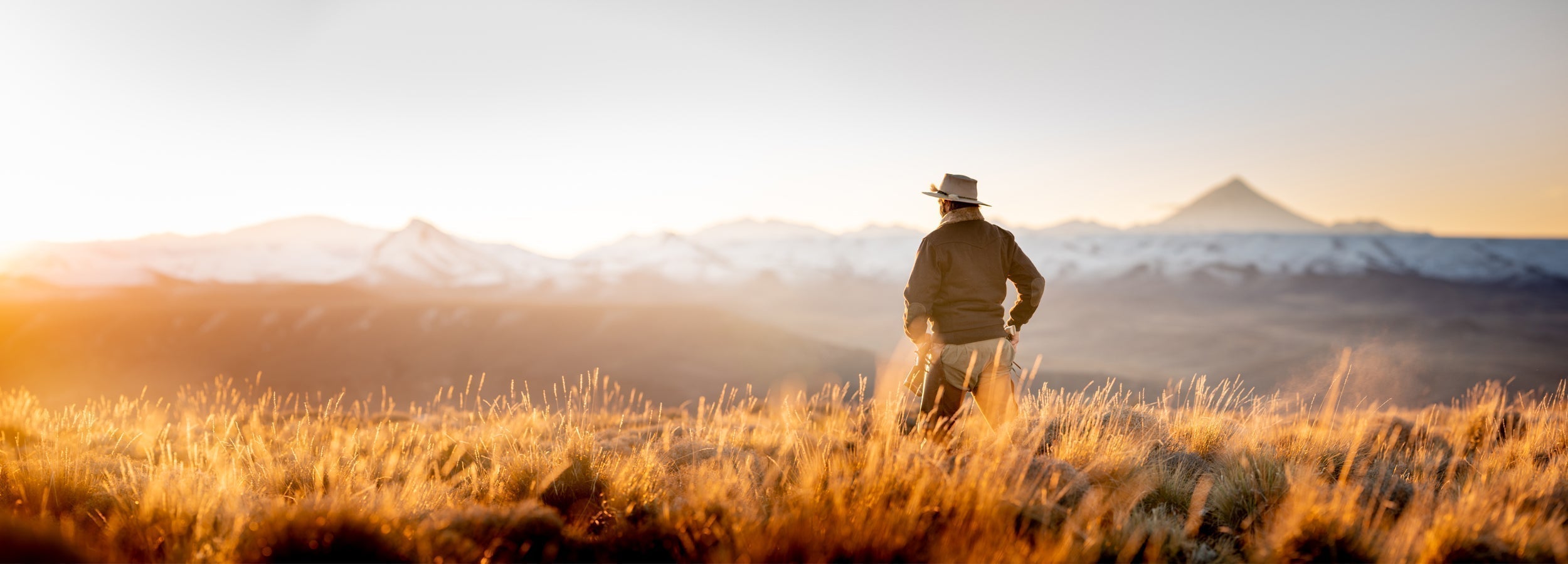
That foundation is what Tewün is built on. We work with merino wool, leather, silk, alpaca and cashmere, materials that come from this land and from traditions that understood this land before we did. We build garments the way Arturo built a life: with care, with patience, and with the understanding that what you make should outlast the moment in which you made it.
Richard bought land he had never seen because he understood that some decisions don't require certainty. They require conviction. Arturo rode alone through the Andes in the dark because he understood that the work is the point, not the comfort.
This isn't heritage as a marketing word. It's where we actually come from.
The land shaped the man. The man shaped the garment.